
Creative Machines and Human Expression: Co-creation, Authorship, and the Meaning of Making
Joy, AI & Humanity: Chapter 8

Joy, AI & Humanity is the working title of a book in development. This is Chapter 8. Your thoughts will change what gets published. Please read, comment, like, and share
The lights are low at the open mic night, casting a warm glow on the small, crowded room. A performer takes the stage and, after a brief introduction, begins to recite a poem. The words flow with an unexpected grace, weaving together images of loss and resilience that seem to tap directly into a collective well of quiet grief and hope. The rhythm is impeccable, the language both surprising and deeply familiar. As the final line hangs in the air, the room is still, caught in a shared moment of profound emotional connection. A few people wipe their eyes. The applause that follows is not just polite; it is genuine, heartfelt. The poem has done what all good art aims to do: it has moved its audience, creating a bridge between the performer and the crowd, between strangers united by a shared feeling.1
Then, a hand goes up during the brief pause before the next act. “That was beautiful,” a voice from the back calls out. “But who wrote it?”
The question, simple and direct, shatters the spell. The performer hesitates for a moment before admitting that the poem was generated by an artificial intelligence. The atmosphere in the room instantly fractures. The unified emotional response dissolves, replaced by a murmur of debate. Some feel betrayed, their authentic emotional reaction now seeming cheapened, a trick played on them by a machine. Others are fascinated, arguing that the power of the words remains, regardless of their origin. The focus shifts irrevocably from the aesthetic experience—the what of the poem—to its provenance—the how of its creation.3
This moment in a small, dimly lit room serves as a perfect microcosm of one of the most pressing cultural and philosophical debates of our time. It reveals that our relationship with art is not based solely on the final product. It is deeply entangled with a story we tell ourselves about its creation—a story that has, for centuries, been centered on a human consciousness, an author with intentions, struggles, and a subjective experience to share.1 The controversy ignited by the AI poet is not truly about the quality of the art, but about the perceived absence of a human “soul” behind it.6 As we stand on the precipice of a new creative era, the open mic night poses the fundamental question this chapter seeks to explore: If a machine can replicate the output of human expression so perfectly that it moves us to tears, what does that reveal about the value of the human process, and what, ultimately, is the meaning of making?
8.1 The New Collaborators
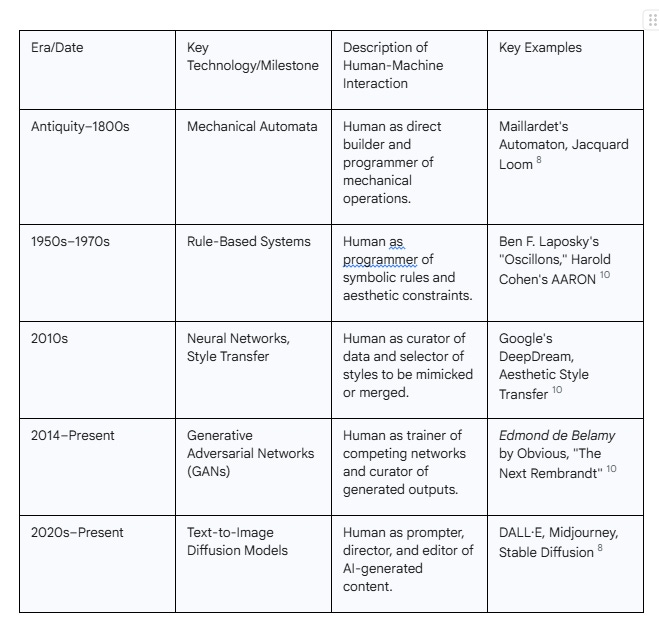
The notion of artificial intelligence as a creative partner may seem like a recent phenomenon, born from the sudden proliferation of tools like DALL·E and ChatGPT, but the dream—and anxiety—of automated creation is woven into the very fabric of human history. The concept of bringing inanimate objects to life to serve or mimic human functions dates back to the automata of Greek mythology, such as the bronze giant Talos, and the medieval legends of the Golem, a clay figure animated by mystical means.8 These ancient stories reveal a long-standing fascination with non-human agency. This impulse found mechanical expression in creations like Maillardet’s automaton around 1800, a clockwork figure capable of writing poems and drawing pictures, and in the 19th-century programmable looms of Joseph Marie Jacquard, which used punched cards to control the creation of complex textiles, a forerunner of industrial software.8
The direct lineage of AI art, however, begins in the mid-20th century, concurrent with the dawn of computing. In 1953, Ben F. Laposky created abstract images he called “Oscillons” using electronic wave generators, with his Oscillon 40 (1952) now considered one of the earliest pieces of digital art.10 Yet, it was the artist and programmer Harold Cohen who, in the 1970s, created one of the most significant early examples of human-machine artistic collaboration: AARON. Cohen developed AARON as a computer program governed by a set of rules and heuristics that could generate intricate, original drawings in his distinctive style.10 AARON was not merely a tool but a proxy creator, demonstrating an early form of autonomous creativity guided by a human artist’s encoded knowledge. Cohen’s decades-long work with AARON, celebrated in a 2024 exhibition at the Whitney Museum of American Art, established a foundational paradigm for AI art: the human as the architect of a creative system.12
The Technological Leap to Generative AI
For decades, computer-assisted art remained a niche field, but a series of technological breakthroughs beginning in the 2010s propelled it into the mainstream. The first major shift came with the rise of deep learning and convolutional neural networks (CNNs). In 2015, Google’s DeepDream program used neural networks to find and enhance patterns in images, producing surreal, dreamlike visuals that captured the public imagination.10 This was followed by the development of “style transfer” techniques, which allowed an AI to apply the aesthetic style of one image—say, a Van Gogh painting—to the content of another, like a personal photograph. These innovations demonstrated that AI could not only generate images but also understand and manipulate artistic style.10
The most significant milestone, however, was the invention of Generative Adversarial Networks (GANs) by Ian Goodfellow and his colleagues in 2014. GANs introduced a novel architecture in which two neural networks—a “generator” and a “discriminator”—compete against each other. The generator creates images, and the discriminator tries to determine if they are real or fake. This adversarial process pushes the generator to produce increasingly realistic and imaginative outputs, effectively “blurring the line between human and AI creativity”.10 The art world took notice in 2018 when Edmond de Belamy, a portrait created by the French collective Obvious using a GAN, sold for $432,500 at Christie’s auction house. This event catapulted AI art into the global spotlight, sparking widespread media coverage and critical debate.10
The most recent and perhaps most disruptive phase began in the early 2020s with the public release of powerful text-to-image models like OpenAI’s DALL·E, Midjourney, and the open-source Stable Diffusion.8 These models allowed anyone to generate high-quality, complex imagery simply by typing a descriptive text prompt. This development dramatically lowered the barrier to entry, transforming AI from a specialized tool for coders and artists into a mass-market technology and setting the stage for the current explosion of creative and ethical conversations.
The Spectrum of Collaboration: Muse, Assistant, or Mimic
The relationship between a human artist and an AI is not monolithic; it exists on a spectrum of collaboration, with the AI adopting various roles depending on the artist’s intent and process.13
At one end of the spectrum, AI serves as a muse. By analyzing vast datasets of images and patterns, AI algorithms can generate novel visual textures, color palettes, and unexpected compositions that can spark a human artist’s imagination and help them overcome creative blocks.6 Photographer-turned-artist Craig Boehman, for example, uses Midjourney to explore conceptual ideas that he lacks the time or resources to photograph himself, using the AI’s output as a starting point for his own vision.7
In the middle of the spectrum, AI acts as an assistant. Here, the technology automates repetitive or labor-intensive tasks, such as generating initial sketches, performing complex color grading, or drafting compositions.13 This frees the human artist from what can be considered drudgery, allowing them to dedicate more time and energy to the higher-level conceptualization, refinement, and emotional core of their work.14
At the far end is the most integrated relationship, where AI functions as a co-creator or mimic. In this model, the AI’s output is not just inspiration or a preliminary step but a direct component of the final artwork. This form of collaboration leads to hybrid creations that merge human sensibilities with machine intelligence.13 Artist Sougwen Chung collaborates with a robotic arm she programmed, named DOUG, which learns from and mimics her drawing style, allowing for a physical duet between human and machine.13 Similarly, artist Claire Silver asserts that her work, which blends anime aesthetics with other styles, could not be made by either her or the AI alone; it is the collaboration itself that bears fruit.12
Stories of Artists Thriving Through Co-Creation
Across the globe, artists are pioneering these new collaborative models, demonstrating that the integration of AI can lead to richer, more nuanced forms of expression.
American artist Amy Karle, who has worked with generative design since 2015, views AI as a “key partner” in her creative process. She emphasizes the “synergy between an artist’s intuition, creativity, and critical thinking combined with AI’s analytical capabilities,” which she believes “opens up new realms of possibility” and results in art that is “not possible to create in any other way”.11 For Karle, human imagination provides the essential direction and purpose for the AI’s vast potential.
Paraguayan artist Kira Xonorika uses AI for “world-building,” creating vibrant imaginary worlds populated by colorful characters. She is fascinated by the “cross-pollination processes that occur with the machine” and the “strength of symbiosis in co-creation.” For her, AI is not just a tool but a medium that allows her to “visualize a reflection of oneself and also actively create worlds”.11
Kenyan film director Barbara Khaliyesa Minishi began using AI during the post-production of her short film Inheritance. She sees AI tools as an “ally” that helps her delve deeper into her narratives and expand the visual and thematic elements of her films, allowing for “additional space for play and experimentation” beyond traditional methods.11
British sculptor Eleanor Crook engages with AI in a more adversarial, investigative manner. She intentionally tries to “wrongfoot the system by entering difficult demands” to produce works with ambiguity and contradiction. In a fascinating turn, she tested the system by asking it to generate a bust in her own style and concluded from the results that the AI had indeed been trained on images of her existing sculptures, revealing the vast, often invisible, data webs these systems draw upon.15
Poet and artist Sasha Stiles has taken collaboration to a new level by creating an AI alter-ego trained on her own body of poetry. She now collaborates with this digital twin, viewing AI not as an alien force but as a natural “evolution of our trajectory through this arc of language,” a new way to store memory and explore expression.12
The evolution from Harold Cohen programming AARON’s every rule to Sasha Stiles collaborating with an AI trained on her own soul-baring poetry reveals a fundamental shift. The nature of artistic skill is expanding. Early AI art required the artist to be a programmer, to construct the creative system from the ground up. Today’s generative AI asks the artist to be a director, a curator, a poet, and a critic. The skill is no longer solely in the manual dexterity of the hand but in the conceptual clarity of the mind, the linguistic precision of the prompt, and the aesthetic judgment required to guide a powerful, non-human collaborator toward a desired vision. As Sebastian Sanchez, a manager of digital art at Christie’s, observes, “AI art is so fascinating, because you see artists bending the technology to their will. They’re putting restraints in place, building parameters and then letting AI run free within those boundaries”.12 This redefinition of artistic labor challenges traditional arts education and forces a confrontation with a deeply held cultural belief: the idea that true art must be born from struggle.
8.2 What Is Art Without Struggle?
For centuries, Western culture has been captivated by the Romantic ideal of the suffering artist—the tortured genius whose personal turmoil and immense effort are not merely incidental to their work but are the very crucible in which great art is forged. This narrative inextricably links the value of an artwork to the perceived struggle of its creator. We value the finished painting more when we hear of the artist’s poverty, the symphony more when we learn of the composer’s deafness, the novel more when we know of the author’s personal tragedies. This framework suggests that art’s worth is measured not just by its aesthetic qualities but by the human sacrifice embedded within it.5 The rise of generative AI, which can produce beautiful and complex works in seconds, directly challenges this foundational myth and forces the question: Does the process still matter if the output is beautiful?
The debate splits along a philosophical fault line, pitting the importance of process against the primacy of the final product. Proponents of the process-centric view argue that art is fundamentally a “conduit for human connection”.5 From this perspective, an artwork is not just an object but a vessel carrying the artist’s intent, emotion, and subjective experience. The value lies in this perceived connection to another human mind. As one observer noted, “The creativity from a human-made artwork seems more soulful,” a sentiment reflecting the belief that the effort and emotional investment of the artist imbue the work with a unique depth that a machine cannot replicate.5 Critics of AI art often echo this, claiming that machine-generated work “has neither intent nor carries a possibility of human connection,” and is therefore a fundamentally different and lesser category of object.5
On the other side of the debate are those who argue that the aesthetic experience of the output is what truly matters. If an AI-generated song is emotionally moving, does its non-human origin negate that genuine human response? As one scholar asks, “Can we get to a point where an AI-generated ballad makes us cry?”.1 If the answer is yes, then the origin may be secondary to the effect. This view is supported by a startling 2024 study in which participants were shown pairs of unlabeled artworks, one human-made and one generated by DALL·E 2. The results revealed a significant preference for the AI-generated pieces.16 This suggests that when stripped of the cultural baggage associated with authorship, the intrinsic aesthetic qualities of AI art can be not only comparable but even superior to human art in the eyes of an observer. The moment the origin is revealed, however, a negative bias often emerges, demonstrating that our judgment is heavily influenced by the story of creation, not just the creation itself.17
The Disappearing Line Between Craft and Prompt
This debate is further complicated by how AI is blurring the definition of “craft.” Traditionally, artistic craft has been associated with years of dedicated practice to master a physical medium—the sculptor’s chisel, the painter’s brush. The relative ease and speed of AI generation can lead to “questions about the depth and rigor of the creative process,” fostering concerns about the “devaluation of human artistry” as the time and effort once required are seemingly bypassed.5
However, to dismiss prompting as effortless is to misunderstand the nature of this new skill. Crafting an effective prompt is not a simple act of typing a few words. It is an iterative, dialogic process that requires a deep understanding of language, aesthetics, and the idiosyncratic behavior of the AI model. Artists like Eleanor Crook describe intentionally crafting “difficult demands” to push the system beyond its generic defaults and achieve a specific, ambiguous vision.15 This process involves experimentation, refinement, and a form of conceptual problem-solving that constitutes a new kind of digital craft. The struggle has not been eliminated; it has been relocated from the physical to the linguistic and conceptual realms.
The psychology of how we perceive creativity adds another layer of complexity. It is not an objective assessment of the final product alone. A 2024 study from Aalto University demonstrated this by showing participants identical drawings and varying how much of the creation process they witnessed. When viewers saw only the final drawing, they rated it as less creative than when they saw a video of the process, and less creative still than when they saw the full act of a robot arm physically making the drawing.18 The key finding was that “the more people saw, the more creative they judged it to be”.18 This reveals a fascinating human bias: we are more inclined to attribute creativity when we can witness a process of creation, even a non-human, mechanical one.
The long-held valuation of “struggle” in art may be less about a romanticized notion of suffering and more about a fundamental human need to perceive agency and process. The problem with much AI art is not that it is effortless but that its process is often an invisible, instantaneous “black box”.1 The Aalto University study suggests that the absence of a visible process may be a key reason why AI art is sometimes perceived as less creative. The study where unlabeled AI art was preferred shows that the aesthetic object can succeed on its own terms, but the fact that revealing its origin often diminishes its value shows that the story of its creation is a powerful modulator of our appreciation. It appears, then, that the value of art is not an objective property but a story we tell ourselves—a story in which a discernible process of making, attributed to a specific agent, plays a central role. This suggests a path forward for artists using AI: by making their collaborative process transparent—by sharing their prompts, their iterations, their curatorial choices—they can construct a new kind of creation story. This new narrative is not about suffering, but about a fascinating dialogue between human and machine, a story that audiences can connect with and value in its own right.
8.3 Ownership and Originality: Copyright, Authorship, and the Remix Economy
As artificial intelligence carves out its territory in the creative landscape, it has run headlong into a legal and philosophical minefield centuries in the making: the concepts of ownership and originality. The questions are fundamental. Who owns an image generated by an algorithm? Can a machine be an author? And what does originality mean when every creation is derived from a dataset of pre-existing human culture? These are not abstract quandaries; they are being actively litigated in courtrooms and debated within government bodies, with the outcomes poised to shape the future of creative expression.
The Legal Black Hole: Can AI Art Be Copyrighted?
The central pillar of modern copyright law, particularly in the United States, is the human authorship requirement. The U.S. Copyright Office has long maintained that to be eligible for copyright protection, a work must be “created by a human being”.19 This principle has been consistently upheld by courts, which have reasoned that the language of the Copyright Act—vesting ownership in an “author”—implicitly refers to a human. This standard has been used to deny copyright to works produced by non-human entities, from photographs taken by a monkey to messages allegedly dictated by divine spirits.20
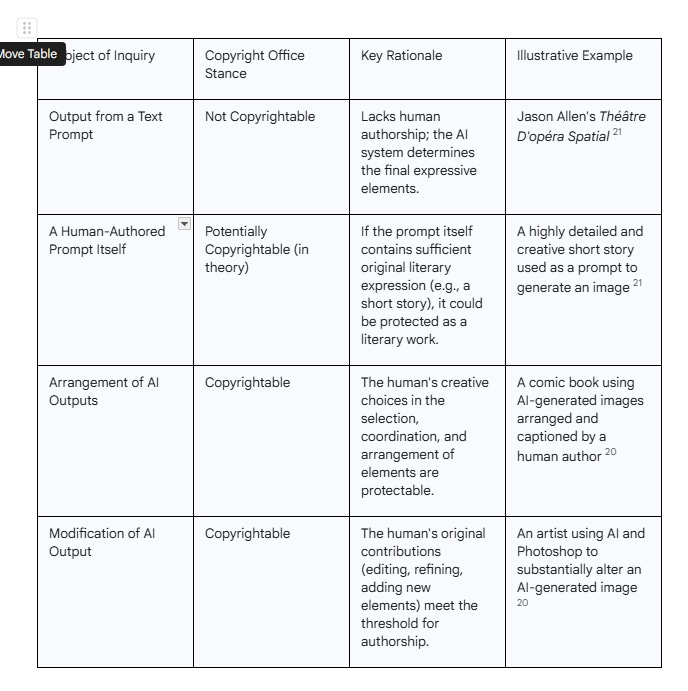
Applying this principle to artificial intelligence, the Copyright Office has issued clear, if evolving, guidance. A work generated entirely by an AI system without meaningful human intervention is considered a purely machine-generated work and cannot be copyrighted.20 The controversial case of Jason Allen’s Théâtre D’opéra Spatial, which won a state fair art competition, is a prime example. Because it was generated directly from a text prompt with the AI determining the final expressive elements, the U.S. Copyright Office has ruled it ineligible for protection.21
The legal terrain becomes more complex for AI-assisted works. The use of AI as an assistive tool—analogous to a camera for a photographer or a digital tablet for an illustrator—does not automatically disqualify a work from copyright.20 The decisive factor is the degree of human creative control. The Copyright Office examines each case to determine “the extent to which the human had creative control over the work’s expression”.19 If a human’s creative choices are sufficiently reflected in the final output, the work may be protectable.
The Status of Prompts and Modifications
This distinction between tool and author hinges on the nature of the human input. The Copyright Office currently views text prompts as unprotectable ideas or instructions rather than copyrightable expression. A user’s prompt may articulate an idea—for example, “a cat smoking a pipe and reading a newspaper”—but it does not control the specific expressive elements of the output, such as the cat’s breed, its pose, the style of the pipe, or the lighting of the scene. The AI system fills these gaps based on its own internal algorithms, meaning the human prompter lacks the requisite control over the final expression.20 The fact that the same prompt can produce vastly different outputs on subsequent runs further supports the view that prompts lack the clear directional control needed to establish human authorship.20
Copyright protection can, however, be secured for the human’s original contributions to an AI-assisted work. This requires a level of creative intervention that goes beyond simple prompting. The Copyright Office has identified several scenarios where human authorship may be present:
Arrangement and Selection: A human who selects and arranges a series of AI-generated images into a larger, cohesive work, such as a comic book, can claim copyright over that specific arrangement and the narrative it creates. The protection covers the human’s creative choices in selection and sequencing, not the individual AI images themselves.20
Substantial Modification: An artist who takes an AI-generated image and significantly modifies, adapts, or refines it using digital editing tools can claim copyright in their original contributions. The key is whether the human’s additions and changes are substantial enough to meet the threshold of creativity.20
Derivative Works: If an artist feeds their own original, human-created artwork (like a sketch) into an AI system with instructions to modify it, the resulting image may be considered a copyrightable derivative work. In this case, the copyright protects the new expressive elements layered on top of the pre-existing, human-authored work.20
The following table summarizes the U.S. Copyright Office’s current guidance, providing a crucial reference for creators navigating this new legal landscape.
The Fair Use Quagmire and the Remix Economy
Beyond authorship, an even more contentious legal battle is brewing over the data used to train these AI models. Generative AI systems are trained by exposing them to colossal datasets containing billions of images and texts, much of which is copyrighted material scraped from the internet without the original creators’ permission or compensation.3 AI companies argue this constitutes “fair use,” a legal doctrine that permits limited use of copyrighted material without permission for purposes such as criticism, research, and transformation. Artists and creators, however, argue it is mass-scale copyright infringement that devalues their work. This conflict is at the heart of several high-profile lawsuits, and its resolution will depend on how courts apply the four factors of fair use: the purpose and character of the use, the nature of the copyrighted work, the amount used, and, crucially, the effect on the potential market for the original work.3
This legal struggle reflects a broader cultural shift. AI art can be seen as the ultimate expression of the “remix economy.” No AI model creates from a blank canvas; its “imagination” is a statistical tapestry woven from the sum of human culture it has ingested. This reality demolishes the romantic myth of the solitary genius creating ex nihilo and forces a confrontation with the inherently derivative nature of all creativity. It also raises a profound cultural question: If an artwork is made by a machine that has learned from everyone, does it truly belong to anyone?.3
The legal framework, in its attempt to answer these questions, is inadvertently shaping the future of artistic practice. By denying copyright to the simple, direct output of a prompt, the law is creating a powerful incentive for artists to move beyond the role of a passive prompter. To secure ownership and legal protection for their work, artists must become active collaborators, editors, arrangers, and modifiers. They must be able to document their creative process and demonstrate their “meaningful authorship” through tangible, creative interventions.20 In this way, the constraints of copyright law are pushing artists toward the very practices of curation and refinement that represent the most sophisticated and compelling forms of human-AI co-creation. This could lead to a split in the creative landscape: a vast ocean of ephemeral, uncopyrightable images for transient use, and a more deliberate, legally defensible form of “AI-assisted art” where the human’s curatorial vision is central, demonstrable, and ultimately, ownable.
8.4 The Democratization of Creativity: Empowerment or Homogenization?
One of the most powerful narratives surrounding generative AI is its potential as a great democratizing force. Proponents argue that by making sophisticated creative tools accessible and affordable, AI is breaking down historical barriers to artistic expression.22 Historically, creating high-quality art required specialized training, expensive materials, and access to institutional resources, effectively limiting participation to a privileged few. Today, with just a computer and an internet connection, individuals from all backgrounds can leverage AI-powered platforms to visualize their ideas, explore their artistic talents, and participate in the creative process.6 This shift has been heralded as the dawn of a “new literacy,” a future where everyone can be a director, a designer, or a storyteller.22
Projects like ID.8, an open-source tool developed at Johns Hopkins University, are explicitly designed with this goal in mind. By integrating text, audio, and image generation into a single, intuitive workflow, ID.8 aims to make the creation of visual stories like webtoons accessible to beginners without requiring specialized coding or artistic skills.24 The creators see it as a “co-creative agent” that can amplify a broad range of perspectives and enhance human creativity rather than replacing it.24
This empowerment narrative is most compelling when it focuses on amplifying underrepresented voices. Filmmaker Willonius Hatcher, for instance, has used AI to produce professional-quality trailers that have resonated with audiences, demonstrating the technology’s potential to help creators who lack industry connections or funding.22 The personal story of Luis, an artist who goes by the name “impAIred,” offers an even more profound example. After experiencing a series of devastating personal tragedies, including losing his home and his wife, and later being diagnosed with adult ADHD, Luis turned to AI art as a form of therapy and a vital outlet for expression. Living with minimal resources, he found that AI provided a medium he could access. “It allows someone like me to express himself artistically, who otherwise would not have a chance,” he states, viewing AI as a lifeline for “countless wannabe artists out there”.25
The Homogenization Counter-Argument
Despite these powerful stories of empowerment, a significant counter-argument looms: the risk of cultural homogenization. This concern stems from the very nature of how AI models are built and operate. First, these systems are trained on vast datasets scraped from the internet, which inevitably reflect existing societal biases. Unless carefully mitigated, AI models will replicate and amplify these biases, leading to stereotypical or skewed representations of gender, race, and culture.3 An AI curator trained on historical auction data is likely to favor “traditional, white, male artists,” while one trained on social media aesthetics will promote “viral, high-engagement styles”.3
Second, because AI learns from statistical patterns in its training data, it tends to gravitate toward popular trends and familiar aesthetics. This can lead to a “homogenization of creative outputs,” creating an “echo chamber of similar ideas” that marginalizes less mainstream or unconventional art forms.27 The result could be a “digital environment that favours conformity over diversity,” eroding the unique character of local cultural expressions and pushing global aesthetics toward a bland, algorithmic mean.28 This trend is exacerbated by the potential for AI-generated content to flood the market, creating a sea of low-quality “slop” that devalues the work of human artists and may even reduce demand for their skills.6
Culturally Distinct Uses of Common AI Tools
However, the narrative of inevitable homogenization is challenged by numerous examples of communities and individuals using these common tools in unexpected and culturally distinct ways. The outcome, it seems, is not predetermined by the technology but is shaped by the user’s intent.
Cultural and Linguistic Preservation: Google’s Woolaroo project is a powerful example of AI being used to foster diversity, not erase it. The open-source tool uses AI-powered object recognition to help language communities preserve and expand word lists for endangered languages, including Louisiana Creole, Māori, and Yiddish. Here, a global technology is being applied to reinforce hyper-local cultural identity.30
Exploring Specific Histories: At the University of Miami, Professor Shai Cohen’s “Sephardi & ChatGPT” course tasks students with using generative AI to explore the history and culture of Sephardic Jewish communities. Students create personalized narratives of forced conversions and digital story maps tracing migration routes, using AI as a tool for deep, specific historical and cultural inquiry.31
New Cultural Narratives: The fear that AI will produce a single, globalized aesthetic is countered by artists who use it to explore their unique cultural contexts. Singapore-based artist Niceaunties uses AI to create works about aging and liberation from her specific cultural viewpoint.12 Malaysian filmmaker Eddie Wong used text-to-image tools to generate visuals for a film exploring his grandfather’s disappearance and his family’s memories, using AI as a medium to probe the intersection of technology, memory, and Malaysian history.11
The concept of democratization, therefore, is not a neutral force. It is a double-edged sword whose outcome is determined by the agency and intention of the user. When used passively or uncritically, AI can indeed become a force for homogenization, defaulting to the most common patterns in its data and reinforcing mainstream aesthetics. However, when wielded with a strong sense of purpose—whether to preserve a language, investigate a history, or express a specific cultural identity—the same technology becomes a powerful tool for empowerment and diversity. AI is a cultural amplifier; it magnifies the intent fed into it. A generic prompt for a “cool picture” will likely yield a generic result. A prompt rooted in a deep cultural or personal narrative, however, can produce something entirely new and specific. The fight against homogenization, then, is not a technological problem to be solved, but a cultural and educational one. It requires fostering a critical “AI literacy” that empowers individuals and communities not just to use these tools, but to bend them to the will of their own unique stories.11
8.5 Curation as the New Creativity
The democratization of creative tools has led to an unprecedented explosion of content. With generative AI, anyone can produce a passable song, a striking image, or a coherent paragraph of text in seconds. This deluge of content has fundamentally altered the creative economy. In an environment of infinite production, the bottleneck of creativity is no longer generation; it is discernment. The world is, as one analyst put it, “overflowing with outputs, yet starving for meaning”.32 In this new landscape, the ability to select, refine, contextualize, and imbue content with a point of view—in short, human taste—becomes the scarce and therefore premium commodity. The critical skill is no longer simply collecting or creating content, but “knowing what to ignore”.33
This shift elevates the role of the curator from a peripheral figure to a central creative agent. Traditionally, curators in museums and galleries have acted as gatekeepers, their authority based on expertise and access to limited collections.32 In the age of AI, their role evolves into that of sense-makers. They become “interpreters and bridge-builders,” tasked with navigating the overwhelming tide of digital content and “translating the language of AI analytics into meaningful human experiences”.32 Their function is to “select, shape, and refine” the noise of infinite generation into a coherent and authentic message.33
AI can be a powerful partner in this task. Curators are already using AI to analyze vast digital collections, identify hidden patterns, and create personalized museum experiences for visitors.34 The Rijksmuseum in Amsterdam, for example, has used AI to digitize and curate its extensive collection, while the Musée des Hospitalières in Montreal uses it to catalog its archives and uncover new thematic connections between artifacts.36 However, a reliance on purely algorithmic curation carries significant risks. As noted previously, AI systems trained on historical data can amplify past biases, and those optimized for engagement may favor popular or viral content over more challenging, avant-garde, or culturally significant work.3 The human curator’s judgment remains essential to provide balance, context, and a critical perspective.
The Artist as Curator
This concept of curation as a primary creative act extends beyond the museum and applies directly to the artistic process itself. The model of production for AI art is highly distributed, with authorship spread across the human prompter, the AI model’s architecture, and the vast dataset on which it was trained. In this paradigm, the artist’s role necessarily shifts from that of a solitary creator of objects to a “translator and curator” of the possibilities the system generates.38
The creative process for many AI artists is not a single act of prompting but an extended dialogue of curation. It involves generating dozens or even hundreds of images, sifting through them to find the one that resonates with their vision, and then iteratively refining, editing, and contextualizing that output. The artist’s unique vision is expressed not through the initial act of generation, but through the series of choices they make. Their authorship is located in their taste, their judgment, and their ability to guide the process toward a specific aesthetic or conceptual goal.
This changes the relationship between the artist and their audience. When the tools of creation are common and accessible to all, it is the artist’s unique perspective and curatorial sensibility that distinguishes them. This can foster a stronger and more personal connection with an audience, who are drawn not just to a single artwork but to the artist’s entire point of view. As scholar Claire Benn argues, in an age of abundant AI-generated works, human-authored art will be prized for the authenticity and connection it offers. The “cult of personality,” exemplified by figures like Taylor Swift whose fans feel a deep connection to her perceived subjective experience, becomes a more central force in the arts.1 The successful artist in the age of AI may be the one who can cultivate a strong, clear, and compelling personality that emanates through their curated choices, giving their audience access to their “person, tastes, and passions”.1
The traditional model of creativity, centered on the idea of origination from a “blank canvas,” is fundamentally broken by AI. The canvas is never blank; it is pre-loaded with the entirety of the model’s training data. Consequently, the primary creative acts available to the artist are selection, combination, editing, and refinement—acts that fall squarely under the definition of curation. In this new paradigm, curation is not a secondary activity that happens after the art is made; it is the primary creative act. Authorship is asserted not through the manual making of the pixels, but through the vision that guides the selection and arrangement of those pixels. This has profound implications for how we value art. If the artistry lies in the curation, then the value may reside less in a single “masterpiece” and more in the coherence and distinctiveness of an artist’s entire body of work. The artist’s aesthetic, their “brand,” becomes their principal creative output. The most influential artists of the AI era may be those who are not only brilliant visual directors but also master communicators, capable of articulating the “why” behind their choices and building a community around their unique and discerning eye.
8.6 Human Meaning in Machine-Made Worlds
Beneath the complex layers of technology, law, and aesthetics lies a simpler, more fundamental question: Why do we create in the first place? To understand the future of human expression in an age of creative machines, we must first understand the timeless psychological drivers of creativity itself. The human urge to make things is not a modern luxury but an evolutionary inheritance. Long before alphabets or canvases, our ancestors painted on cave walls, told stories around fires, and sang myths into collective memory.2 Expression through language, symbol, and art is a primary way humans have always made sense of their world, adapted to changing environments, and sought to leave a mark that says, “I was here”.2
Modern neuroscience confirms that creativity is not a mystical gift but a complex cognitive function involving the dynamic interaction of multiple large-scale neural networks across the brain.39 It requires a flexible dance between different modes of thought: divergent thinking, which generates multiple open-ended ideas, and convergent thinking, which hones in on the single best solution.40 It is deeply interwoven with our memory, our capacity for self-awareness, and our ability to mentally simulate alternative scenarios—to imagine worlds that do not yet exist.39
At its core, however, the drive to create is profoundly social. We make art to be known, to share our internal state, and to connect with others. An artwork can serve as a “window into what [the artist] attends to, what they value, and maybe even what they stand for,” facilitating a unique form of human connection that bridges the gap between individual minds.1 In a world of increasing digital noise, the act of creating—of pausing to reflect and shape an idea—is an act of reclaiming one’s own point of view, a declaration that “I still feel things. I still care”.2
AI’s Role in Modern Rituals and Storytelling
Far from being a purely utilitarian or commercial technology, AI is already being integrated into these deeply human, meaning-making activities, often in ways that enhance rather than diminish our connection to culture and history.
Interactive Museum Storytelling: Institutions are using AI to move beyond static displays and create dynamic, personalized narratives. The São Paulo Art Gallery employs an AI to give a “voice” to artworks, allowing visitors to ask questions and engage in interactive conversations with the pieces.37 The Museum of Tomorrow in Rio de Janeiro uses an AI chatbot to facilitate discussions on sustainability, making the topic personally relevant to each visitor’s life.37 These tools transform the museum experience from passive observation to active dialogue.
Cultural Preservation and Reconstruction: AI is proving to be an invaluable tool for bringing lost or inaccessible cultural heritage to life. Machine learning was used to digitally restore Gustav Klimt’s three “Faculty Paintings,” which were destroyed during World War II, based on the only remaining black-and-white photographs and written descriptions.30 In a remarkable feat of digital archaeology, researchers on the Vesuvius Challenge used AI to read the text within ancient, carbonized scrolls from Herculaneum that were too fragile to unroll physically.42 AI is also used to create immersive virtual reality reconstructions of historical sites like ancient Rome, allowing people to experience the past in a new way.42 These projects use AI not just to digitize, but to reconstruct, interpret, and forge new pathways to our collective history.44
Preserving Language and Identity: As seen with the Woolaroo project for endangered languages and the “Sephardi & ChatGPT” course for exploring specific cultural histories, AI can be a powerful ally in preserving and sharing cultural identity.30 Professor Shai Cohen, who created the course, notes that AI, when thoughtfully applied, can help people grasp the “universality in human nature” by reconciling and connecting disparate cultural layers, becoming a “catalyst for recovering overlooked histories”.31
The Joy of Making—Even When a Machine Could Do It Faster
Despite these powerful applications, the rise of AI also reaffirms the intrinsic value of the human creative process itself. For many artists and creators, the goal is not efficiency. The process of making art is often intentionally “slow, messy, and deeply personal”.6 There is an irreplaceable joy and meaning found in the physical act of creation—the feeling of a brush on paper, the tactile feedback of clay, the intuitive mixing of colors—that an AI can never replicate.6
Artist Roberto Campus argues that the ultimate role of the human artist transcends technical execution. He posits that artists serve as “spiritual intermediaries,” conduits for a kind of divine inspiration or higher insight that a machine, lacking consciousness and lived experience, can never access. In this view, the enduring value of human art lies not in its ability to produce a photorealistic image, but in its unique capacity to “touch the human soul” and connect us to something beyond the material world.45
This reveals a critical distinction: AI is a powerful tool for our quest for meaning, but it is not a source of meaning. The machine has no inherent intent, no “why” behind its creations.5 The most compelling and valuable applications of creative AI are those where humans have applied this powerful technology to a task of profound humanistic importance—restoring lost art, deciphering ancient texts, preserving a dying language. The machine does not provide the purpose; humans do. This suggests that the most enduring legacy of creative AI may not be found in the art gallery, in works that simply mimic human aesthetics, but rather in the museum, the archive, the classroom, and the community center. In these spaces, AI can serve as a revolutionary catalyst for connection, preservation, and understanding, augmenting our timeless human quest to make meaning in the world.
Closing: Singing with the Ghost in the Machine
The open mic night is drawing to a close, but the performer of the AI poem returns to the stage. The room, still buzzing with the earlier debate, quiets down. This time, the poet doesn’t just recite the poem. They reveal their process. They explain how the final piece was not a single, instantaneous command, but the result of a long and intimate collaboration. They describe feeding the AI fragments of their own journals, lines from their grandparents’ letters, and disjointed memories of a childhood home. They show on a small screen how they sifted through dozens of nonsensical or generic outputs, curating and editing, guiding the algorithm’s suggestions, and weaving the machine’s unexpected phrases into a structure that resonated with their own emotional truth. They make their invisible process visible, transforming the “ghost in the machine” from an inscrutable author into a fascinating, if soulless, collaborator.12
A change ripples through the audience. The feeling of being tricked is replaced by a new kind of admiration. They are no longer just appreciating a finished product; they are appreciating a novel and deeply human creative process. Knowing the method does not diminish their emotional response to the poem; it enriches it, adding a layer of intellectual fascination to the aesthetic connection. The mystery of the poem’s origin is replaced by an appreciation for the human’s role as a director, a curator, and a partner in a duet with a powerful new instrument.
This transformation encapsulates the central argument of our new creative era. Human creativity is not being automated away; it is being profoundly transformed. The role of the artist is evolving from one of solitary origination to one of collaboration, direction, and, most critically, meaning-making. The human creator brings the intent, the lived experience, and the “why.” They are the ones who set the parameters, who ask the questions, who sift the digital noise for the signal, and who ultimately decide what has meaning.
AI is not a substitute for human creativity; it is an amplifier, a tool that “enhances the human spectrum of creativity”.12 It allows us to explore what is possible outside the traditional boundaries of our own agency, but not separate from it. The future of art is not a battle between human and machine, but a new synthesis. It is, as Christie’s Director of Digital Art Nicole Sales Giles puts it, about “a new artistic process, one that happens in collaboration with technology”.12 The challenge and the opportunity lie in learning to sing with this ghost in the machine, guiding its powerful voice to express the enduring, messy, and beautiful truths of our own humanity.
Works cited
Eight Scholars on Art and Artificial Intelligence - Aesthetics for Birds, accessed August 1, 2025, https://aestheticsforbirds.com/2023/11/02/eight-scholars-on-art-and-artificial-intelligence/
Why We Still Write: Human Expression in the Age of AI - Westbrae Literary Group, accessed August 1, 2025, https://westbraeliterarygroup.com/blog/why-we-still-write-human-expression-in-the-age-of-ai
AI Art + Curation - Critical Playground, accessed August 1, 2025, https://criticalplayground.org/ai-art-curation/
Interview with an AI Artist. : r/midjourney - Reddit, accessed August 1, 2025, https://www.reddit.com/r/midjourney/comments/10yssx9/interview_with_an_ai_artist/
The Value of Creativity: Human Produced Art vs. AI-Generated Art, accessed August 1, 2025, https://www.scirp.org/journal/paperinformation?paperid=140943
The Pros and Cons of AI Art - Jenna Rainey, accessed August 1, 2025, https://jennarainey.com/pros-and-cons-of-ai-art/
In Defense of AI Art — Craig Boehman, accessed August 1, 2025, https://craigboehman.com/blog/in-defense-of-ai-art
Artificial intelligence visual art - Wikipedia, accessed August 1, 2025, https://en.wikipedia.org/wiki/Artificial_intelligence_visual_art
Timeline of artificial intelligence - Wikipedia, accessed August 1, 2025, https://en.wikipedia.org/wiki/Timeline_of_artificial_intelligence
History of AI Generated Art — DIGITAL ARTS BLOG, accessed August 1, 2025, https://www.digitalartsblog.com/tips/history-of-ai-generated-art
AI, Art, and Creativity: Exploring the Artist’s Perspective, accessed August 1, 2025, https://www.salzburgglobal.org/news/topics/article/ai-art-and-creativity-exploring-the-artists-perspective
What Is AI Art? | Christie’s, accessed August 1, 2025, https://www.christies.com/en/stories/what-is-ai-art-augmented-intelligence-36dc0897d3584268b5102468a3bf8a8c
Creative Collaboration: How Artists and AI Can Work Together | by Myk Eff | Higher Neurons, accessed August 1, 2025, https://medium.com/higher-neurons/creative-collaboration-how-artists-and-ai-can-work-together-187502fd8fdb
Is AI Alligator or Ally When It Comes to Creativity? | Psychology Today, accessed August 1, 2025, https://www.psychologytoday.com/us/blog/harnessing-hybrid-intelligence/202507/is-ai-alligator-or-ally-when-it-comes-to-creativity
What is AI art? An interview with Eleanor Crook - Research - University of Reading, accessed August 1, 2025, https://research.reading.ac.uk/research-blog/2023/09/27/what-is-ai-art-an-interview-with-eleanor-crook/
Human perception of art in the age of artificial intelligence - Frontiers, accessed August 1, 2025, https://www.frontiersin.org/journals/psychology/articles/10.3389/fpsyg.2024.1497469/full
Human perception of art in the age of artificial intelligence - PMC, accessed August 1, 2025, https://pmc.ncbi.nlm.nih.gov/articles/PMC11750838/
Seeing Is Believing: How We Judge AI as Creative or Not - Neuroscience News, accessed August 1, 2025, https://neurosciencenews.com/ai-creativity-psychology-28870/
Generative Artificial Intelligence and Copyright Law - Congress.gov, accessed August 1, 2025, https://www.congress.gov/crs-product/LSB10922
Clarifying the Copyrightability of AI-Assisted Works | Foley & Lardner ..., accessed August 1, 2025, https://www.foley.com/insights/publications/2025/02/clarifying-copyrightability-ai-assisted-works/
A.I. Art Generated With Text Prompts Cannot Be Copyrighted, U.S. Rules, accessed August 1, 2025, https://news.artnet.com/art-world/ai-art-us-copyright-office-2604297
Democratizing Creativity: The Rise of Generative AI in Digital Art and Storytelling, accessed August 1, 2025, https://www.researchgate.net/publication/385710773_Democratizing_Creativity_The_Rise_of_Generative_AI_in_Digital_Art_and_Storytelling
AI and the Democratization of Art Creation: Revolutionizing the Creative Landscape | by Myk Eff | Higher Neurons | Medium, accessed August 1, 2025, https://medium.com/higher-neurons/ai-and-the-democratization-of-art-creation-revolutionizing-the-creative-landscape-12c76a897561
Democratizing Creativity - Johns Hopkins Whiting School of ..., accessed August 1, 2025, https://engineering.jhu.edu/news/democratizing-creativity/
ARTIST Interview : impAIred. You make various ai art. Can you ..., accessed August 1, 2025, https://medium.com/@abymesurr/artist-interview-impaired-42c87079435e
How Does Ai Influence Cultural Expression? - Lifestyle → Sustainability Directory, accessed August 1, 2025, https://lifestyle.sustainability-directory.com/question/how-does-ai-influence-cultural-expression/
Impact on cultural diversity risk for AI - IBM, accessed August 1, 2025, https://www.ibm.com/docs/en/watsonx/saas?topic=SSYOK8/wsj/ai-risk-atlas/impact-on-cultural-diversity.html
The Boredom of Cultural Homogeneity — Algorithms and AI are disrupting authenticity and diversity | by Wilmien Bos | Medium, accessed August 1, 2025, https://medium.com/@wilmien.bos_74313/the-boredom-of-cultural-homogeneity-algorithms-and-ai-are-disrupting-authenticity-and-diversity-0b8fffa22afe
Cultural Impact Of AI Art Generators and Artificial Intelligence - Airbrush AI, accessed August 1, 2025, https://www.airbrush.ai/blog/cultural-impact-of-ai-art-generators-and-artificial-intelligence
9 ways AI can interact with culture - Google Blog, accessed August 1, 2025, https://blog.google/outreach-initiatives/arts-culture/9-ways-ai-can-interact-with-culture/
Using AI to preserve and share cultural heritage - University of Miami News, accessed August 1, 2025, https://news.miami.edu/as/stories/2025/06/using-ai-to-preserve-and-share-cultural-heritage.html
Creativity and the Curator | Psychology Today, accessed August 1, 2025, https://www.psychologytoday.com/us/blog/the-digital-self/202311/creativity-and-the-curator
Curators in the Age of AI - Ander Group, accessed August 1, 2025, https://www.ander.group/blog/curators-in-the-age-of-ai
Artificial Intelligence in Art Curation and Creation - Kheder Painting Artist, accessed August 1, 2025, https://www.khederpaintings.com/post/artificial-intelligence-in-art-curation-and-creation
AI and Arts | The Alan Turing Institute, accessed August 1, 2025, https://www.turing.ac.uk/research/interest-groups/ai-and-arts
The Rise of the AI Curator: Navigating the Information Deluge in the Age of Generative AI, accessed August 1, 2025, https://shecancode.io/the-rise-of-the-ai-curator-navigating-the-information-deluge-in-the-age-of-generative-ai/
AI-Powered Interactive Storytelling for Museums’ Engagement ..., accessed August 1, 2025, https://cuseum.com/blog/2025/2/6/ai-for-interactive-storytelling-at-museums
The Distributed Authorship of Art in the Age of AI - MDPI, accessed August 1, 2025, https://www.mdpi.com/2076-0752/13/5/149
The Psychology of Creativity | Lesley University, accessed August 1, 2025, https://lesley.edu/article/the-psychology-of-creativity
Creativity | Oxford Research Encyclopedia of Psychology, accessed August 1, 2025, https://oxfordre.com/psychology/display/10.1093/acrefore/9780190236557.001.0001/acrefore-9780190236557-e-608?p=emailAaCNkOQ7vUXE2&d=/10.1093/acrefore/9780190236557.001.0001/acrefore-9780190236557-e-608
Full article: Artificial Creativity? Evaluating AI Against Human Performance in Creative Interpretation of Visual Stimuli - Taylor & Francis Online, accessed August 1, 2025, https://www.tandfonline.com/doi/full/10.1080/10447318.2024.2345430
AI in Historic Preservation | Anderson Archival, accessed August 1, 2025, https://andersonarchival.com/blog/ai-in-historic-preservation/
Artificial Intelligence for Digital Heritage Innovation: Setting up a R&D Agenda for Europe, accessed August 1, 2025, https://www.mdpi.com/2571-9408/7/2/38
AI Integration in Cultural Heritage Conservation – Ethical Considerations and the Human Imperative - Digital Commons@Lindenwood University, accessed August 1, 2025, https://digitalcommons.lindenwood.edu/cgi/viewcontent.cgi?article=1022&context=ijedie
The Role of Artists in the Age of AI – The Art of Roberto Campus, accessed August 1, 2025, https://robertocampus.com/the-role-of-artists-in-the-age-of-ai/